Friday, December 22, 2006

The Legends of St. Osyth


Frithewald, King of the East Angles and first Christian ruler of his tribe, was in constant fear of being attacked by marauding Danes whose notoriety preceded them. They were known for their brutal attacks, sparing no life regardless of age or gender. He and his wife Wilaburga were fearful that their home would be pillaged and their beautiful young daughter, Osyth, would be kidnapped.

Frithewald and Wilaburga were so concerned for Osyth’s safety they sent her away to the relative security of the county of Warwickshire. Her personal care and spiritual guidance were placed in the hands of Abbess St. Moden, who ran a strict priory but provided love and care of her novices.

One day, Abbess St. Moden sent young Osyth on an important mission to visit a nearby priory to collect a precious book from the Abbess St. Edith, sister of King Alfred. Osyth set off pleased that she had been given such a significant task. After her visit to the neighboring priory, Osyth carefully carried away the book, mindful of her duties to guard its safety. However, on her return journey, the weather worsened and as she crossed a bridge, she was swept into the swollen torrents of the fast-moving river.

Three days passed without St. Moden hearing from Osyth so she decided to visit St. Edith herself. St. Edith told the Abbess that Osyth had collected the book as instructed and, after some brief refreshment, had set off on her return trip that same day. Prior to knowing that Osyth was missing, St. Edith had a vision in which an angel told her to visit the river. Believing this to be an omen, the two women set out on their journey fearing the worst, but they found Osyth sitting quietly by the river with the precious book unharmed in her hands.

Another legend concerns Osyth’s adult life. When she became a grown woman, her parents betrothed her to Sighere, King of the East Saxons. She was an obedient girl and would not defy their wishes and so agreed to marry Sighere. On the morning of the wedding, Osyth’s father, the groom and the men of the wedding party noticed a white deer in a clearing of the woods. They took off in pursuit of the deer leaving Osyth and the womenfolk alone. As she sat quietly awaiting her fate, Osyth decided the life of a nun was preferable to becoming Queen of the East Saxons (later to be known as Essex) and she defied her parents’ wishes and stole quietly away to a nearby convent where she quickly “took the veil.” Sighere was devastated when he returned from the hunt but he loved Osyth and only wanted her happiness, so he built her a priory on a quiet inlet on the coast. It was not long before she was ministering to several young novices of her own and pursuing her dream of serving Christ, but the location of the priory proved fateful.

In 653, on a warm summer’s day, a band of Viking pirates led by Hubba and Inguar swept into the village and came upon Osyth’s convent. The Vikings terrorized the nuns but Osyth stood her ground and proclaimed her faith in God. The Viking, Hubba, ordered Osyth to recant her faith and accept his pagan god. She would not, so the infuriated Viking ordered a warrior to severe her head. The order was carried out and according to local legend, after Osyth had been decapitated she gently bent down, picked up her head and walked to the chapel. Once at the chapel door, her bloodied hand pushed it open and she fell dead upon the floor.
An Excerpt from Extraordinary Places ... Close to London

Sunday, November 12, 2006

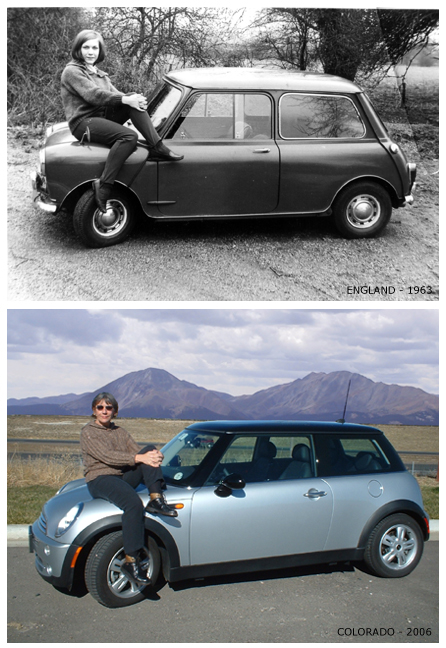
The Mini - Then and Now


It is a different country, different manufacturer and obviously a different place in time, but one thing is for sure, I believe the Mini Cooper is here to stay.
My love affair with the Mini has lasted 40+ years. I grew up, married, raised three handsome sons, now have three beautiful daughters-in-law, and eight fantastic grandchildren, but recently, a new love has crept into my life - my Mini Cooper!

Living in England in the early 60s, my fiancĂ©e, soon to be husband, drove speedily around in his bright red Austin Mini sometimes to the annoyance of other drivers. I remember one incident when a driver, who had been beaten to a parking spot, yelled out “…bloody little thing…I could stamp on it….” Although we loved our old Austin Mini with a passion, a growing family dictated a larger vehicle.

Now, 40 years later, having lived in America for almost 30 years, this grandmother has gone full circle and is now the proud owner of a Mini Cooper. The buying process is of course completely different than it was all those years ago. With the help of a sales associate, one sits at a computer and literally builds the car on screen. Model, style, interior and exterior colors are chosen and then, one of the biggest choices of all for me, whether to choose an automatic gearbox rather than a stick shift. I chose the automatic and wondered later if I would be disappointed, I was not. After three months of “incubation”, which I was able to track on-line, my baby made its debut at Ralph Schomp Mini in Littleton, Colorado, polished and shining from its origin in Cowley, Oxford, England. As the proud owner, I was not sure whether to break open a bottle of champagne or give out cigars!

Evidence of BMWs fantastic engineering in the present day Mini Cooper is everywhere from the sports car like gearbox to the steering and braking capability. The car feels “as one” with the road providing a similar but much better feel than the old Austin model. Having once owned a Porsche 356B and a Mercedes 420 SEL, it was pleasure to discover again the thrill of driving a beautifully engineered car.

My Mini makes me smile – I actually smile at a car!! What’s wrong with me? But I secretly know the answer. For years I have wanted a Mini of my own, but raising a family, having a career and just the responsibilities of life meant I had to purchase a car suitable for my lifestyle. In 2006, with the encouragement of my husband, I chose a car just for myself, and I chose a Mini Cooper. Needless to say, my car is always parked in the nether regions of a parking lot to avoid the inevitable dings that will surely come. But the distance gives me the opportunity to walk slowly towards my car, appraise the workmanship and style to the extent that I always find myself smiling!

Thursday, November 9, 2006

A New Member


The National League of American Pen Women was founded in 1897 as an alternative to the (then) all-male National Press Club. Realizing a need for an organization that would include women of the press, Marian Longfellow O’Donoghue, niece of Henry Wadsworth Longfellow, decided to create such as organization. Along with Margaret Sullivan Burke and Anna Sanborne Hamilton, she made plans for “bringing together women journalists, authors and illustrators for mutual benefits and the strength that comes of union.”

After a fantastic lunch and general discussion, Nancy Bentley was inducted into the National League of American Pen Women by Diane Hoover at their Colorado Springs, Colorado, monthly meeting. Their motto: “One for all and all for one.
www.americanpenwomen.org.

Sunday, November 5, 2006

Victorian Bed and Breakfast


Whether visitors want to walk in the parks, hike the historic districts in Colorado Springs, Manitou Springs or Old Colorado City, the Crescent Lily Inn is ideally located.

The house was built in the Queen Anne style in 1898 by Major Robert Waugh, who was the oldest Civil War Veteran in Colorado when he died in 1929. With the division of Virginia, he took part in the formulation of the Provisional Government of West Virginia in 1861. Major Waugh, who was part Native American himself, went on to accept an appointment as an Indian agent in Utah. When he retired, he and his family moved to Colorado Springs and built their home on Boulder Crescent.


The inn has five guest bedrooms, each with a private bathroom, queen or king sized beds as well as many other amenities. The inn has splendid woodwork, including an impressive staircase. The inn is beautifully decorated with antiques and there is a pleasant, elegant feel about the home especially in the dining room where homemade meals are a delight.
www.cresentlilyinn.com or telephone: 719-442-2331

Wednesday, October 18, 2006

Holst in Essex


Gustav Holst the composer fell in love with Thaxted on first sight when he arrived in the winter of 1913. He and his wife Isobel stayed at the Enterprise, a small guest house in Town Street for a five-day walking holiday. They enjoyed their visit, the people and the town so much that he was determined to return. The following year, Holst leased a small house called Monk Street Cottage, and he and Isobel settled in to make Thaxted their home.

It was a difficult time in England. World War I had just started and anyone with a name such as von Holst (which was his full surname) was looked upon with skepticism and distrust. Holst was eyed with suspicion, especially as he was seen walking alone for hours each day. This came to the attention of the local police constabulary who felt obliged to keep a watch on the strange man as he walked around the village. A policeman’s report noted, “Many rumors are current about this man, but nothing can be traced against him.”

Slowly Holst began to make friends but there was one person in particular, Conrad Noel, who became a close friend. Conrad was deeply involved with village life and introduced Holst to members of Saint John the Baptist Church and the choir. Soon Holst was known warmly as “our Mr. Von” and in 1916 he organized, conducted and played the organ at the Whitsun Festival. One weekend, he brought students from London to join with the Thaxted choir in an unforgettable time of singing and rejoicing. A member of the congregation was quoted as saying that Holst could make the organ “speak.” The organ Holst used to compose some of his famous works is still in Saint John the Baptist Church.

Here in this peaceful town of Thaxted, Holst was able to work on his Planets Suite as well as many of his other symphonies. In 1924, while recovering from a bout of illness, he completed Choral Symphony and wrote to a friend, “It has been wonderful to sit all day in the garden and watch the symphony grow up alongside of the flowers and vegetables, and then to find that it is done!”

Sunday, October 1, 2006

Quilt Folklore


The Log Cabin quilt (c. 1870s) shown in the above photo is showing the wear of 150 years. The Log Cabin quilt (alternatively called the Courthouse Steps) traditionally has a center of a different color. Folklore has it that if the center square of the panel is yellow that indicates a light in the home (imagine riding across the prairie and seeing a light in the window of your home). Red in the center signifies the hearth of a home and a black square indicates a ‘safe house’ or home owner who was sympathetic to the Underground Railroad, an organization that helped those fleeing slavery. Since not everyone could read and write in those days, it was often necessary to communicate by other means. By hanging a quilt with a black center square over a washing line, a bush or veranda, a traveler could see at a glance whether a particular home would welcome them and give them safe harbor.

Tuesday, September 19, 2006

Devils Tower (Bear Lodge)


Since seeing the movie Close Encounters of the Third Kind almost 30 years ago, I have wondered if Devils Tower or Bear Lodge as some Indians referred to this special place, was really as impressive as I had seen on the silver screen. On a recent trip to the area, I was not disappointed.

The drive from Denver to Wyoming takes approximately seven hours and although my previous trips had included Mount Rushmore and Crazy Horse’s monument, Devils Tower had been excluded, but was now on my agenda.

The drive from Mount Rushmore to Devils Tower, America’s first national monument takes approximately two hours. It is a pleasant drive often with many deer or pronghorns in the grasslands along the route. The looming tower, all 867 feet can easily be seen on Highway 24 on the approach to the National Park.

On arriving at the tower, we were surprised to see that climbers were allowed to scale the tower. Park service personnel described how climbers’ pitons had been used in the past to secure their hold, but nowadays, most climbers used their own strength and skill to carry them to the summit. Almost 4000 climbers visit the tower each year to test their skill on the massive rock. The National Park Service considers the rock to be a valuable and historical monument and one that is to be enjoyed by all, including climbers.

There is an excellent winding path around the base of Devils Tower. The hike is relatively easy and takes about 45 minutes for the 1.3 mile walk. At various intervals around the base, there are spectacular, panoramic views with many opportunities for excellent photographs.

On exiting the park, there is a well stocked gift shop that also offers light refreshments. Located across the road from the gift shop, there is a Post Office where one can mail postcards presumably with the postmark “Devils Tower”.

It was a good trip and well worth the extra time and energy to visit Devils Tower.