Sunday, April 30, 2006

The Forerunner of Shorthand?


Marcus Tullius Tiro was an ex slave born in a small village called Arpinum, in Italy about 60 miles south east of Rome. Tiro was an intelligent man who, in 63 BC, became secretary to Senator Cicero, a man who was known to enjoy hearing his own voice. He often gave long speeches in his own particular oratory style in the Senate of Rome. But, as Tiro watched and listened, he saw an opportunity to please and be of extra value to his master. He devised a method of recording his master’s speeches using his own specific marks that he could later transcribe to a proper written form. Cicero was delighted to know his speeches were recorded and could be read back to him verbatim.

Although the concept of recording speeches verbatim had been attempted by the Greeks many years earlier, it was Tiro who mastered the speed writing technique that is perhaps the forerunner of shorthand as we know it today. Tiro shared his technique with other scribes but it was not to stop there, soon Tiro’s Marks were taught in the schools of Rome. During Tiro’s employment for Cicero, he recorded more than 600 speeches and letters using his own specialized method of rapid writing.

Over the centuries, those people who had the ability to transcribe speeches and letters verbatim were highly valued employees. These scribes adapted and changed the characters to suit the particular employment, business or profession. Therefore only they could transcribe their own marks making that individual a highly prized employee.

Today, Pittman shorthand is the most commonly used method of taking dictation and recording speeches and letters. Even in the Houses of Parliament, London, speeches are still recorded verbatim by transcribers who work on rotation. The reporters work for five or ten minutes, then they re-dictate to a secretary who types up the transcripts.

Charles Dickens was just such a transcriber. He worked in the Houses of Parliament for almost six years and was well thought of by his colleagues. One contemporary described Dickens as “universally reputed to be the rapidest and more accurate shorthand-writer in the gallery” and another wrote, “A more talented reporter never occupied a seat in the Gallery of either House of Parliament.”

Here in the US, a fledgling Senate struggled with recording the speeches given by its members. A brochure called The Official Reporters of Debates of the U.S. Senate prepared under the direction of Walter J. Stewart, Secretary of the Senate, states that sometimes the reporters had difficulty hearing the speeches and even identifying the speaker. During the First Congress, Thomas Lloyd privately reported and published the debates describing the speakers as “the baldheaded man” or “the man in blue coat and wig.”


Assistant U.S. Senate Historian Betty K. Koed reported that “the last of the Senate's Reporters of Debates who used shorthand retired in the 1980s. Other reporters had begun using stenographic machines, in place of shorthand methods, in the late 1970s.”

While he served as majority leader of the United States Senate, Lyndon B. Johnson once observed that there were few documents more important than the congressional record “Locked in its pages are the debate, the resolutions, the bills, the memorials, the petitions...and that without the able, loyal, hard working, highly skilled corps of Official Reports who take down the debates.”

Sunday, April 23, 2006

Boadicea, Queen of the Iceni


Boadicea, Queen of the Iceni tribe, reigned over the counties we now East Anglia with her husband Prasutagus from approximately 48AD to 60AD. She was a fine woman by all accounts, standing as tall as a man with a booming voice that could not be ignored. The Greek, Dio Cassius, described her as “a Briton woman of the royal family” and of having a mass of red locks “the tawniest hair” that hung to her waist.

During the year 43AD, the Emperor Claudius sent approximately sixty thousand troops to finally subdue the Britons. The Iceni made peace with the Romans and Prasutagus was permitted to keep his kingdom until his death in 60AD.

On the eve of his death, Prasutagus wrote a will stating that half his kingdom would be left to his wife and two daughters. The other half would pass to Rome. Boadicea would be the beneficiary of her daughters’ inheritance until they came of age or when they married, in which case it would be used as a dowry.

The Romans saw Prasutagus’ death as an opportunity to seize the whole kingdom by claiming Prasutagus’ estate owed back taxes that were due immediately. Boadicea challenged the claim and, unable to justify the accusations, the Romans knew their scheme had failed leaving only one option. They instructed their soldiers to remove Boadicea by force, to crush and humiliate her.

Records of the time tell us that Boadicea was taken from her home and publicly flogged. The noblemen and women were heartbroken as they watched in horror at the treatment of their Queen. The shame was almost too much for Boadicea to bear, but the final blow came when her teenage daughters were taken from her and brutally ravaged by the Roman soldiers.

Queen Boadicea felt such fury and humiliation that she swore revenge on Rome and the Roman people and collected an army of over one hundred thousand people from various tribes that had never surrendered to the Romans and who now joined forces with the Iceni Queen.

First, Boadicea set her sights on Colchester, the foremost Roman city in England. The 9th Legion of the Roman army was guarding Colchester but they were no match for Boadicea and her soldiers. The city was quickly burned to the ground. News of Boadicea’s success spread through Britain and many people, sensing victory over the Romans, joined the fight. It is believed that Boadicea’s army totaled over 200,000 men and women at the final battle.

Boadicea’s next target was London. In anticipation of her arrival, the city was almost deserted but she kept her promise and pillaged and burned the town until nothing was left.

After the victories in Colchester and London, Boadicea and her army marched home full of triumph and accomplishment. They were greeted with cheers and happiness for ending the oppressive rule of Rome.

The Romans, ashamed and disgraced that a woman could inflict such devastation decided to use their best and most aggressive troops led by Suetonius Paulinus to contain the uprising. Paulinus commanded the 14th and 20th Legions who were known to be particularly fierce and combative. The legions had been fighting the Druids for control of Wales but now turned their attention south towards Boadicea’s army.

The actual location of the final battle site between the Roman legions and Boadicea is unknown but according to Tacitus, a Roman historian, Boadicea appeared “tired and injured, in her clan tartan and armed to the teeth…in appearance, almost terrifying.” Some say she was captured and died from poison taken by her own hand. Others say she died in prison from wounds inflicted during the battle. Either of these would have been preferable to being taken to Rome and subjected to harsh treatment or even execution in the gladiatorial arena.

Read more about Boadicea and Colchecter Castle in my book Extraordinary Places ... Close to London

Monday, March 13, 2006

What Do You See?


Each day as I walk past this tree stump, I see a face. Depending on the light, the deeply set eyes appear to be more pronounced, the long thin nose reminds me of someone – but whom?

On an impulse, I decided to email the image to some friends and family to see what they thought. I wanted to know if others also saw the same image. Only one friend said she could not see a face, and perhaps questioned my sanity. Susan couldn’t see anything except a stump with bark falling off. Well, there goes the imagination! But I can see an image, and he’s looking right back at me. Some friends and family tell me they see the face of Abraham Lincoln, while others can definitely see an image but can’t put a name to the face. Others have nicknamed him The Bark Man and The Man in The Tree. What do you see?

Monday, February 27, 2006

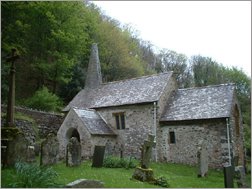
Culbone Church, Somerset.


As I did my research for a new travel book on the West Coast of England, I came across a little church that is said to be “...the smallest complete parish church in this country.” It is mentioned in the Guinness Book of Records and also the Domesday Book, a book compiled by William the Conqueror’s scribes to document every village, man, woman, and livestock in England for taxation purposes. The information collected was recorded in a book the English people feared so much they nicknamed it The Domesday Book, after God’s final judgment.

My journey began behind the local pub where the publican had asked if I was “really going to the church?” He told me I faced a 5 miles round-trip and that I’d “better get going if you’re to be back before dark.”

Not deterred, I set off immediately and stayed on the footpath that at times veered towards a particularly beautiful, rugged coastline of Exmoor, but then turned inland through typical English woodland. At one point on the trail, I felt quite uneasy as I had to walk though a tunnel that was dark and very wet with thick moss covering the walls. As I exited the tunnel, I had the distinct feeling I was being “watched” and it suddenly dawned on me that I was either being very brave or very foolish to undertake this adventure on my own.

After about one hour’s hike and just when I thought I should turn back and try another day, I came upon the church. It was so beautiful it literally took my breath away. I scrambled through the last few hundred yards of woodland and could hardly wait to see inside.

Over the centuries, various repairs and renovations have been taken place on Culbone Church, yet it has retained its beauty. The walls are original and thought to be 12th century. The font is very old, probably Norman but the pedestal is believed to be Victorian. The nave is thought to be Saxon (pre 1066) but this cannot be confirmed. The churchyard cross has a 15th century base but a relatively new cross that was erected in 1966.

After a few minutes of sitting quietly in the church and the churchyard, it was time for me to get back to the village, but the church’s location intrigued me. Why was it here so far from the village? The church sits atop a 400 feet wooded area with Porlock Bay to the north and Lynton and Lynmouth to the west. Perhaps 1,000 years ago, the church was more than adequate for the small community. The church can only accommodate 33 parishioners, but still has services regularly.

Mindful of the time, I quickly made my way back to the village and the dreaded “tunnel.” With courage in both hands, I literally ran through the tunnel and breathed a sign of relief on exiting. Then the strange feeling was with me once more and I quickly turned in all directions but saw nothing. Before long, I was back in the pub and decided to order some supper. The publican asked if I had made it to the church and I stood straight up and replied that I had some excellent photos. He then asked if at any time, had I been scared or felt as though I had been watched. In amazement, I told him that the area around the tunnel gave me goose bumps and why did he ask. He told me the area was once a Leper Colony and that lepers used to flock to the church to receive communion. The publican said that many people have commented on the strange feelings they have encountered as they make their way to Culbone Church.

Saturday, February 18, 2006

Blind Man’s Buff (Bluff)

In a world where we amuse ourselves with personal digital assistants and children interact with GameBoys and PS2s, it was fun to go back in time and see what families and friends did for amusement before these items existed, and even before the advent of television or radio.

As a child, I remember playing parlour games such as musical chairs, charades, or ‘Blind Man’s Buff’, which was one of the most popular games. The game was played by adults and children especially at birthday parties and other social gatherings. Although I have been unable to find the origin, I understand a similar game was played during medieval times, suggesting the game is more than 500 years old.

Many of these games were brought from England and mainland Europe to America by families seeking a better life in the New World. Some of the games were adapted and softened such as the last line in Ring a Ring of Roses. In England, the last line of the game is, “All fall dead.” In America, the ending,” All fall down.”

As I researched the origin of Blind Man’s Buff (some people say “Bluff”) I wondered if other games such as Marco Polo and Hide and Go Seek also derived from the original Blind Man’s Buff game. The games are very similar in nature particularly Hide and Go Seek; although in this game the main participant (the seeker) has only to cover his or her eyes while counting to a specific number designated by the group.

Blind Man’s Buff is usually played in a closed room with about eight to ten people. One person is designated to be blindfolded and, after a scarf is tied around their eyes, he or she is spun around three times to disorientate them. This gives the other participants a chance to scatter and move around the room. The blindfolded player then makes their way around the silent room with his or her arms outstretched as they try to ‘feel’ one of the other participants. As they make their way around the room, the blindfolded person naturally bumps into furniture or knock lamps down, much to the amusement of those attending the party. The squeals of laughter sometimes lead the seeker to an individual who, once caught must then become the seeker themselves and so the game continues.

During 1888, the press referred to the game of Blind Man’s Buff to embarrass and humiliate the police force who had been unable to arrest Jack the Ripper. Although the police arrested several men, they were quickly released for lack of evidence. A cartoon was published by Punch Magazine showing the police as the “blind man” which was obviously meant to shame the police. It depicts a London policeman in uniform with a scarf around his eyes. His arms are outstretched in an effort to catch any individual who may fall into his grasp. On the wall there is a poster with the word “Murder” as its title. Unsavory characters surround the policeman and tease him. The caption beneath the cartoon reads: Blind Man’s Buff (As Played by the Police.) “Turn round three times and catch whom you may.” The Ripper was never caught.

Friday, December 30, 2005

The Witch Finder General


Mathew Hopkins was given the ominous title of Witch Finder General because of his ability to find witches and “persuading” them to confess. He was paid twenty shillings, a tidy sum in the mid 1600s, for each witch he brought to justice. The business became so lucrative that he formed his own close-knit crew to comb the countryside seeking out witches of both genders. At one time, he had 32 people under arrest of whom 19 were hanged in one day. Hundreds of people died, mostly women, many of whom died under torture or in prison.

At the end of his career, Hopkins’ techniques (and wealth) came to the attention of Parliament who demanded an explanation for his cruel antics. Hopkins submitted a pamphlet to Parliament in 1647 called The Discoverie of Witches defending his actions and techniques but he was nonetheless removed from his position. During Hopkins’ reign of terror, almost four hundred men and women from local villages and towns had been condemned to death, sometimes for merely owning a cat! Matthew Hopkins is buried in Mistley Towers, a little village east of Manningtree, Essex, England.

The county of Essex in England was evidently a favorite place to hunt witches. It is known that when Elizabeth I became Queen of England; she encouraged the seeking out of witches. She stayed at St. Osyth, Essex, in 1561 and again in 1579 in the company of Lord John D’Arcy who took it upon himself to rid the village of witches.

Lord D’Arcy lived in the village of St. Osyth at St. Clere’s Hall, St. Osyth, Essex, England. In 1582, Brian D’Arcy, Justice of the Peace in St. Osyth, conducted searches for witches in the village and neighboring areas. He used the same persuasive techniques as Matthew Hopkins and by all accounts he was a successful witch hunter. A book in the Bodleian library, Oxford, states that, “A true and just recorde of the enformation, examination and confession of all witches taken at St. Osees.” The evidence consisted of accusations by neighbors and even family members of supposed witchcraft. Two local women, Elizabeth Bennet and Ursula Kemp were branded as witches. Ursula’s own son, Thomas, gave evidence against his mother at the trial. The two women were found guilty and hanged for witchcraft in 1582.

In 1921, a man digging in his garden at 37 Mill Street came upon two skeletons. The main joints of the women were bound, elbow to elbow, wrist to wrist. The skeletons are believed to be the remains of Elizabeth and Ursula, and we can only assume that they were bound together to prevent them escaping their joint grave.


The above are excerpts from my book Extraordinary Places...Close to London (Page 24 & 26)

Sunday, December 11, 2005

The Tea Ceremony and Other Customs


As an ardent traveler, it has been a pleasure to observe the various customs and traditions of the countries I’ve visited. So many times, a traveler may inadvertently offend a person in a host country without ever realizing they have done so – a problem I intentionally tried to avoid on a recent trip to Japan.

Originally from England, I am a tea lover, and, as most people know, we Brits take our tea drinking seriously. On my first visit to Japan, I decided to attend a formal, tea ceremony having always wondered if there was a “proper” way to serve tea, and so set off to the nearest teahouse. I was part of a group of six people, who were led through a garden and into a teahouse. The host took considerable time in preparing the tea and handed it to us in tiny cups without handles. The host used both hands as she handed the cups to each of us. In each instance, she turned the cups so that the design on the front of the cup was facing the recipient. We were told it was customary to accept the cup in both hands, and then turn the cup around so the design now faced the host. This ritual had to be observed before drinking the tea; to not do so would have been unacceptable behavior.

A similarly important ritual exists for distribution of business cards in Japan. I have been at meetings in America and England where people have handed business cards around the table like a croupier at a Blackjack table. Not so in Japan where one offers a business card with two hands and a slight nod of the head. The card is accepted using both hands. After all, it is a precious item and not to be offered or accepted without ceremony.

I believe the best way to see a country and meet the people is to travel they way they do, so I took a trip on the Tokyo underground train system. Of course, all destinations were written in Japanese and since I do not speak Japanese, I had to enlist the help of fellow passengers. I was surprised and delighted to note that many people spoke English. Once asked, they took the time to find out where I was going and point that destination out on the map, help me purchase a ticket from the automated machines, and direct me to the trains. By the way, there is no mistaking the direction to the trains as there are literally official footprint markings leading to and from the platforms on the underground. I noticed that everyone, without exception, followed the footsteps in an orderly fashion. Needless to say, I followed suit, and was pleasantly surprised to see how clean the trains were and how everyone boarded and exited the trains. The whole process of traveling on the underground Tokyo transit system was a real experience and one that I recommend other visitors.