skip to main |
skip to sidebar
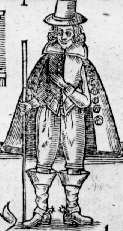 Mathew Hopkins was given the ominous title of Witch Finder General because of his ability to find witches and “persuading” them to confess. He was paid twenty shillings, a tidy sum in the mid 1600s, for each witch he brought to justice. The business became so lucrative that he formed his own close-knit crew to comb the countryside seeking out witches of both genders. At one time, he had 32 people under arrest of whom 19 were hanged in one day. Hundreds of people died, mostly women, many of whom died under torture or in prison.
At the end of his career, Hopkins’ techniques (and wealth) came to the attention of Parliament who demanded an explanation for his cruel antics. Hopkins submitted a pamphlet to Parliament in 1647 called The Discoverie of Witches defending his actions and techniques but he was nonetheless removed from his position. During Hopkins’ reign of terror, almost four hundred men and women from local villages and towns had been condemned to death, sometimes for merely owning a cat! Matthew Hopkins is buried in Mistley Towers, a little village east of Manningtree, Essex, England.
The county of Essex in England was evidently a favorite place to hunt witches. It is known that when Elizabeth I became Queen of England; she encouraged the seeking out of witches. She stayed at St. Osyth, Essex, in 1561 and again in 1579 in the company of Lord John D’Arcy who took it upon himself to rid the village of witches.
Lord D’Arcy lived in the village of St. Osyth at St. Clere’s Hall, St. Osyth, Essex, England. In 1582, Brian D’Arcy, Justice of the Peace in St. Osyth, conducted searches for witches in the village and neighboring areas. He used the same persuasive techniques as Matthew Hopkins and by all accounts he was a successful witch hunter. A book in the Bodleian library, Oxford, states that, “A true and just recorde of the enformation, examination and confession of all witches taken at St. Osees.” The evidence consisted of accusations by neighbors and even family members of supposed witchcraft. Two local women, Elizabeth Bennet and Ursula Kemp were branded as witches. Ursula’s own son, Thomas, gave evidence against his mother at the trial. The two women were found guilty and hanged for witchcraft in 1582.
In 1921, a man digging in his garden at 37 Mill Street came upon two skeletons. The main joints of the women were bound, elbow to elbow, wrist to wrist. The skeletons are believed to be the remains of Elizabeth and Ursula, and we can only assume that they were bound together to prevent them escaping their joint grave. The above are excerpts from my book Extraordinary Places...Close to London (Page 24 & 26)

As an ardent traveler, it has been a pleasure to observe the various customs and traditions of the countries I’ve visited. So many times, a traveler may inadvertently offend a person in a host country without ever realizing they have done so – a problem I intentionally tried to avoid on a recent trip to Japan.
Originally from England, I am a tea lover, and, as most people know, we Brits take our tea drinking seriously. On my first visit to Japan, I decided to attend a formal, tea ceremony having always wondered if there was a “proper” way to serve tea, and so set off to the nearest teahouse. I was part of a group of six people, who were led through a garden and into a teahouse. The host took considerable time in preparing the tea and handed it to us in tiny cups without handles. The host used both hands as she handed the cups to each of us. In each instance, she turned the cups so that the design on the front of the cup was facing the recipient. We were told it was customary to accept the cup in both hands, and then turn the cup around so the design now faced the host. This ritual had to be observed before drinking the tea; to not do so would have been unacceptable behavior.
A similarly important ritual exists for distribution of business cards in Japan. I have been at meetings in America and England where people have handed business cards around the table like a croupier at a Blackjack table. Not so in Japan where one offers a business card with two hands and a slight nod of the head. The card is accepted using both hands. After all, it is a precious item and not to be offered or accepted without ceremony.
I believe the best way to see a country and meet the people is to travel they way they do, so I took a trip on the Tokyo underground train system. Of course, all destinations were written in Japanese and since I do not speak Japanese, I had to enlist the help of fellow passengers. I was surprised and delighted to note that many people spoke English. Once asked, they took the time to find out where I was going and point that destination out on the map, help me purchase a ticket from the automated machines, and direct me to the trains. By the way, there is no mistaking the direction to the trains as there are literally official footprint markings leading to and from the platforms on the underground. I noticed that everyone, without exception, followed the footsteps in an orderly fashion. Needless to say, I followed suit, and was pleasantly surprised to see how clean the trains were and how everyone boarded and exited the trains. The whole process of traveling on the underground Tokyo transit system was a real experience and one that I recommend other visitors.
 Cayman Brac is the furthest of the three islands that make up the Cayman Islands. The islands are located at 480 miles due south of Miami. Grand Cayman is the largest with Little Cayman and Cayman Brac to the east.
The Brac is approximately 11 miles long and about 2 miles wide at the center, with roads around the coastline and linking roads through the middle. There is little nightlife on the island, so visitors should expect to keep themselves busy sightseeing, eating, drinking and diving. For birdwatchers, the island hosts more than 200 species of birds. The parrot sanctuary is well worth a visit. Although we were not able to actually set eyes on a parrot in its natural habitat, we certainly heard their screeching, so knew they were watching us.
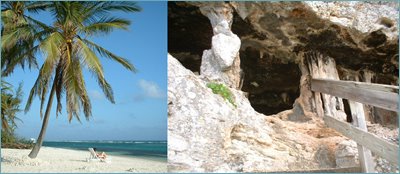
Besides having some of the most beautiful reefs in the world, the island has several interesting caves. Islanders have taken refuge in these caves during hurricanes, especially Peter’s Cave which is located high on a cliff overlooking Spot Bay at the East End. Half Way Ground Cave and the Bat Cave are also worth a visit. As water drips through the limestone, holes appear in the rocks. At certain times during the day, the sun streams through the holes and provides enough light for small plants to grow.
The lush, green tropical forest of the interior of the island compliments the rugged coastline, but there are few places for the diver to access the water easily from the shoreline. On a scheduled dive, we were taken to the Cayman’s version of the Lost City of Atlantis. A local sculpture known as “Foots” is in the process of creating a likeness of the mythical city of Atlantis. To date, he has assembled several columns, a sundial and a statue. We were pleased to note the site can be approached by land from Stake Bay and then of course a short swim to the underwater site.
Stake Bay is also great for those visitors who merely like to snorkel and free dive. The reef has an abundance of fish and coral and it was literally like swimming in an aquarium. Every fish imaginable can be seen from the tiny, iridescent beauties to the quite large, barracuda and stingrays.
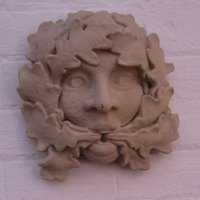 In 1939, Lady Raglan wrote an article titled The Green Man in Church Architecture so first used the term for this little known mystical creature, thought to be a symbol of fertility. He comes to us in three basic forms: The Disgorging Head that displays vegetation from its mouth; the Bloodsucker Head that spews vegetation from mouth, nose, ears and eyes and finally the Foliate Head that is simply covered in leaves and other foliage. His grinning image often appears in English villages unexpectedly on a church ceiling, a pew, column or church door. He has been intricately carved, painted, worshipped and reviled but through the centuries, he has remained a favorite topic of stonemasons.
Many believe the origin of the Green Man began in Rome, as there is some evidence of similar figures that can be seen in early Roman culture. What we know is that some time later, Christians adopted the Green Man because we see his likeness in churches throughout the United Kingdom and Europe. In 1154, Augustinian Monks established a church in Yorkshire that was destroyed during the Reformation. Only the nave of the church remains but there is a splendid boss depicting a likeness of the Green Man sprouting a leafy tendril from his eye and yet another from his mouth. In St. Martin’s church, Norfolk, there are three images of the Green Man each showing a different type of foliage.
After the Reformation when so many churches were either badly damaged or in some instances completely razed, it is fortunate that many churches containing the carved imagine have remained. Perhaps it was easier to destroy a beautiful stained glass window than a roof boss, font or screen, which contained a depiction of our mystical creature. One can only imagine the orders to destroy, by cannon fire, anything of beauty in a church. In many instances, they were completely destroyed or left as mere shells of their former splendor. However, many churches were spared and in these we find evidence of the Green Man. No two images are exactly the same, as the stonemasons appear to play with us. In one they portray him laughing and then, in the next instant, depict him in an angry mood.
There is another instance where there is mention of Green Men. During the Stuart and Tudor times, there were certain men in the village whose job it was to keep the crowd back at a safe distance during a procession of royalty or local dignitaries. They wore their hair long and often covered themselves in leaves or vines. Whether this attire was an attempt to intimidate the crowd into compliance, we can only guess, but these men were also known as “whifflers” or “wild men” and also Green Men.
Nowadays, the image of the Green Man can be seen on pub signs throughout England, as he is a very popular character. But, if you plan on visiting England, be prepared to see his grinning face bearing down on you from a church beam, ceiling or corbel watching your every move.
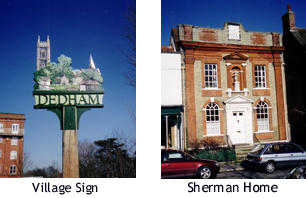 The Domesday Book reports that in 1086, Dedham had a population of over two hundred people and various livestock. The book was prepared by William the Conqueror after his invasion of England in 1066. His scribes were sent into the countryside to assess the population and livestock of each village so a tax could be levied against all the wealth in the land. So feared were the Britons of this inventory, they named the book after God’s final Day of Judgment.
Dedham and the surrounding towns are known as Constable Country after John Constable, the famous landscape painter. His beautiful paintings depicting the country scenes he loved so much adorn museums around the world.
John Constable so cherished this countryside that he wrote, “I love every stile and stump and lane…these scenes made me a painter and I am grateful…I had often thought of pictures of them before I ever touched a pencil.”
The son of a prosperous corn merchant, Constable was born in 1776 in East Bergholt, Suffolk, just across the border of Essex. His parents owned two mills; one at Flatford, the subject of one of his popular paintings and the other at Dedham. He attended the Grammar School in Dedham under the strict direction of Dr. Grimwood who was the Headmaster at the time. He was a good student by all accounts but prone to dreaming. His intellectual ability was expected to bring him a position in the church, but his love of sketching and painting everyday scenes took him in a different direction. Often he would take his father’s barge from the mill along the stream directly to school. We know from comments he made later that he noticed everything, “no two days are alike, not even two hours; neither were there ever two leaves of a tree alike since the creation of the world.”
In 1799, when he was twenty-three year old, Constable was accepted as a probationer in the Royal Academy Schools in London. His work was not considered particularly interesting but when he began his “six footers,” most notably The White Horse, a biographer remarked that Constable “was too large to remain unnoticed.”
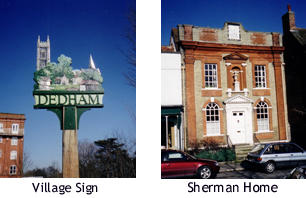
The Sherman Home
Located across the road from St. Mary the Virgin church sits the Sherman home. It is good condition and still in use even today. At least six of the Sherman children emigrated to the United States of America between 1633 and 1640. They became the co-founders of Rhode Island, signatories of the Declaration of Independence, as well as becoming other notable dignitaries.
 Benjamin Franklin, an advocate of fire safety in the home, wrote an article in his Gazette suggesting: “In the first Place, as an Ounce of Prevention is worth a Pound of Cure, I would advise ‘em to take care how they suffer living Coals in a full Shovel, to be carried out of one Room into another, or up or down Stairs, unless in a Warmingpan shut; for Scraps of Fire may fall into Chinks and make no Appearance until Midnight; when your Stairs being in Flames, you may be forced, (as I once was) to leap out of your Windows, and hazard your Necks to avoid being oven-roasted.”
This was sound advice from Mr. Franklin who was one of the first to suggest the need for a body of men who would be available to fight a fire, perhaps a “Club or Society of active Men belonging to each Fire Engine; whose Business is to attend all Fires with it whenever they happen.”
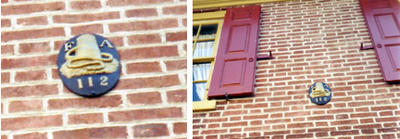
On a recent trip to Philadelphia and a tour around the historic district, I was pleased to see that many old buildings have retained the original fire marks of their respective insurance companies, some of which began in England and then moved to America. These new businesses were both lucrative and competitive. On acceptance of a policy, the insurance company installed their fire mark on the insured building, usually on the first floor where it could easily be seen. Originally, the fire marks were made of lead and cast in a mold with the insurance company’s number under a unique emblem. They were decorated in bright colors and sometimes included a gold leaf accent. However, from 1780 to 1800, the high cost of lead made the fire marks too expensive, so copper, tin or a mixture of metals was used. Fire marks designs varied considerably with each insurance company. The Fire Association of Philadelphia (c. 1817) displayed a hose wrapped around a pump while the Insurance Company of North America depicted an eagle and a hose.
Insurance companies organized their own fire brigades to protect their clients’ properties. The men of these brigades were chosen for their strength and disposition. They wore magnificent, colorful uniforms that easily distinguished members of one brigade from another. The men of a brigade were proud and often gregarious by nature. When an alarm sounded, each brigade set off to discover the whereabouts of the fire. If the building displayed a rival’s fire mark, the brigade not only let the property burn, but actually impeded the legitimate brigade’s attempts to douse the fire by kicking over their competitors’ leather buckets, swearing or physically fighting while the building burned to the ground.
Anyone who saw the movie Gangs of New York might remember there was just such an incident where rival firefighters literally took to fisticuffs over a fire as the building was razed to the ground.
 What are leylines? Are they merely ancient paths or do they hold some kind of mystical earth power? Is it true that UFOs have been seen in the sky following leylines?
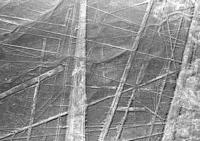
Growing up as I did in the County of Essex, England, I had heard about leylines but it was not until I did research for my book Extraordinary Places…Close to London (see page 37) that I realized there are leylines in other parts of the world too. The Lines of Nazca, Peru (see photo), the Altiplano of Bolivia, and right here in the United States, we have the Great North Road on the Chaco in Arizona. These as well as other locations around the world all offer similar characteristics: long straight roads with monuments, churches, rings of stones, places of historic interest, etc. that mark the way. Often these leylines cannot be seen from ground level but can be clearly seen from the air. Why would that happen?
One of the first people to notice and document leylines in England was Alfred Watkins (1855-1935) who was an avid photographer. Watkins’ son, Allen, later wrote about his father’s discovery. “Then without any warning it all happened suddenly. His mind was flooded with a rush of images forming one coherent plan. The scales fell from his eyes and he saw that over many long years of prehistory, all trackways were in straight lines marked out by experts on a sighting system. The whole plan of The Old Straight Track stood suddenly revealed.”
Interestingly, the leylines in England do follow a straight path over terrain that could be more easily navigated by a circuitous route. This is true in other countries too where the tracks have taken a traveler up and over a mountain rather than an easier route around it. Is there some reason to keep a track straight?
Watkins never gave us an explanation for these ancient tracks that are now called leylines. Dowsing experts have followed the leylines and tell us there is subterranean water activity. To this day, pilots follow leylines as they navigate the skies, so is it so strange to think that if we have been ‘visited’ by UFOs, they would also follow the same lines? Many believe animals possess extra sensitivity to earth power and congregate at certain spots that have been deemed leylines. When something strange happens in a village, the incident is often expressed as, “…well, what do you expect, it’s on a leyline…”