skip to main |
skip to sidebar
 Whether visitors want to walk in the parks, hike the historic districts in Colorado Springs, Manitou Springs or Old Colorado City, the Crescent Lily Inn is ideally located.
The house was built in the Queen Anne style in 1898 by Major Robert Waugh, who was the oldest Civil War Veteran in Colorado when he died in 1929. With the division of Virginia, he took part in the formulation of the Provisional Government of West Virginia in 1861. Major Waugh, who was part Native American himself, went on to accept an appointment as an Indian agent in Utah. When he retired, he and his family moved to Colorado Springs and built their home on Boulder Crescent.
The inn has five guest bedrooms, each with a private bathroom, queen or king sized beds as well as many other amenities. The inn has splendid woodwork, including an impressive staircase. The inn is beautifully decorated with antiques and there is a pleasant, elegant feel about the home especially in the dining room where homemade meals are a delight. www.cresentlilyinn.com or telephone: 719-442-2331
 Gustav Holst the composer fell in love with Thaxted on first sight when he arrived in the winter of 1913. He and his wife Isobel stayed at the Enterprise, a small guest house in Town Street for a five-day walking holiday. They enjoyed their visit, the people and the town so much that he was determined to return. The following year, Holst leased a small house called Monk Street Cottage, and he and Isobel settled in to make Thaxted their home.
It was a difficult time in England. World War I had just started and anyone with a name such as von Holst (which was his full surname) was looked upon with skepticism and distrust. Holst was eyed with suspicion, especially as he was seen walking alone for hours each day. This came to the attention of the local police constabulary who felt obliged to keep a watch on the strange man as he walked around the village. A policeman’s report noted, “Many rumors are current about this man, but nothing can be traced against him.”
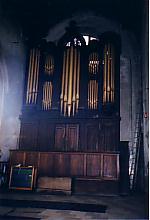
Slowly Holst began to make friends but there was one person in particular, Conrad Noel, who became a close friend. Conrad was deeply involved with village life and introduced Holst to members of Saint John the Baptist Church and the choir. Soon Holst was known warmly as “our Mr. Von” and in 1916 he organized, conducted and played the organ at the Whitsun Festival. One weekend, he brought students from London to join with the Thaxted choir in an unforgettable time of singing and rejoicing. A member of the congregation was quoted as saying that Holst could make the organ “speak.” The organ Holst used to compose some of his famous works is still in Saint John the Baptist Church.
Here in this peaceful town of Thaxted, Holst was able to work on his Planets Suite as well as many of his other symphonies. In 1924, while recovering from a bout of illness, he completed Choral Symphony and wrote to a friend, “It has been wonderful to sit all day in the garden and watch the symphony grow up alongside of the flowers and vegetables, and then to find that it is done!”
 The Log Cabin quilt (c. 1870s) shown in the above photo is showing the wear of 150 years. The Log Cabin quilt (alternatively called the Courthouse Steps) traditionally has a center of a different color. Folklore has it that if the center square of the panel is yellow that indicates a light in the home (imagine riding across the prairie and seeing a light in the window of your home). Red in the center signifies the hearth of a home and a black square indicates a ‘safe house’ or home owner who was sympathetic to the Underground Railroad, an organization that helped those fleeing slavery. Since not everyone could read and write in those days, it was often necessary to communicate by other means. By hanging a quilt with a black center square over a washing line, a bush or veranda, a traveler could see at a glance whether a particular home would welcome them and give them safe harbor.

Since seeing the movie Close Encounters of the Third Kind almost 30 years ago, I have wondered if Devils Tower or Bear Lodge as some Indians referred to this special place, was really as impressive as I had seen on the silver screen. On a recent trip to the area, I was not disappointed.
The drive from Denver to Wyoming takes approximately seven hours and although my previous trips had included Mount Rushmore and Crazy Horse’s monument, Devils Tower had been excluded, but was now on my agenda.
The drive from Mount Rushmore to Devils Tower, America’s first national monument takes approximately two hours. It is a pleasant drive often with many deer or pronghorns in the grasslands along the route. The looming tower, all 867 feet can easily be seen on Highway 24 on the approach to the National Park.
On arriving at the tower, we were surprised to see that climbers were allowed to scale the tower. Park service personnel described how climbers’ pitons had been used in the past to secure their hold, but nowadays, most climbers used their own strength and skill to carry them to the summit. Almost 4000 climbers visit the tower each year to test their skill on the massive rock. The National Park Service considers the rock to be a valuable and historical monument and one that is to be enjoyed by all, including climbers.
There is an excellent winding path around the base of Devils Tower. The hike is relatively easy and takes about 45 minutes for the 1.3 mile walk. At various intervals around the base, there are spectacular, panoramic views with many opportunities for excellent photographs.
On exiting the park, there is a well stocked gift shop that also offers light refreshments. Located across the road from the gift shop, there is a Post Office where one can mail postcards presumably with the postmark “Devils Tower”.
It was a good trip and well worth the extra time and energy to visit Devils Tower.
 They are sometimes called mazes or labyrinths but there is a slight distinction between the two terms. Generally, mazes are considered easier to negotiate since they have no blind alleys or dead ends. Labyrinths, on the other hand are considered a little more challenging. Webster’s Dictionary defines a labyrinth as “...a place constructed of or full of intricate passageways and blind alleys...something extremely complex or tortuous in structure, arrangement or character....” In any event, most writers tend to use the term maze and labyrinth interchangeably, as I will do in this column.
Mazes have been found throughout the world and appear to have early origins. In the 5th century BC, a Greek traveler, Herodotus, discovered a labyrinth in Egypt. He was so impressed with the size and complex nature of the labyrinth that he wrote “I found it greater than words could tell...even the pyramids were surpassed by the Egyptian labyrinth.” Herodotus also states that the labyrinth was built on two levels had 3,000 chambers and that a massive stone wall encircled the structure.
Some believe that mazes were created to admonish people who had behaved badly and therefore needed to reflect on their past conduct. These individuals would be placed in the center of the maze and asked to escape. In doing so, they would experience dead ends, blind alleys, interlocking triangles and concentric circles. It was hoped that as an individual tried to escape the confinements of a maze, he might equate those experiences to real life, and therefore consider his options more carefully and make better decisions in the future.
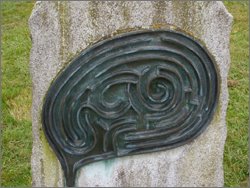
Seen in this photograph is an unusual headstone to Michael Ayrton who was known as a master maze builder. It holds an 18” double spiral bronze labyrinth replica of the Arkville labyrinth Ayrton in New York. The tombstone is located in St. Botolph’s churchyard in Essex, England. It is located on the north east corner of the churchyard on left-hand side of the gravel path. Visitors to Ayrton’s graveside have run their fingers through the bronze plaque trying to locate the beginning and end of the puzzle. Even in death, Ayrton still has the ability to perplex people.
An excerpt in Extraordinary Places…Close to London.
 Earl Steinbicker, who edited my book Extraordinary Places ... Close to London, has written or edited 17 books in a highly successful series called "Daytrips” and now he has launched a blog called Life’s Little Adventures.
From Earl's blog:
"• World Traveler • Commercial Photographer • Author • Book Editor • And More • I've been all of these, and now I'm older and ready to tell all that I've learned — back in the prehistoric times before computers — and how I've come to terms with today's technology. Hello, my name is Earl Steinbicker and I'll frequently include complete one-day adventures from my books that you can take, as experienced by myself and my little gang of travel writers. Along the way, you'll meet a few celebs (even living ones!), hear my rants about the publishing business, and experience some unusual happenings. Enjoy!"
 Some people refer to Carlsbad Caverns as the eighth wonder of the world and on a recent visit, I can see why. Take the elevator 758 feet below the surface to see such impressive formations that are hard to describe here. The stalagmites and stalactites produced over thousands of years are spectacular. The caverns also host of hundreds of thousands of bats that leave each night on their nightly hunt for food.
A cowboy, Jim White first discovered the caves at Carlsbad but few people believed his tales of the beautiful formations under the ground. Then, in 1915, a friend, Ray V. Davis accompanied White to the caverns and took some photographs. Once those photographs were made public, scores of people visited the caves but it wasn’t until 1923 that the U.S. Department of the Interior took an interest and sent an inspector to assess the caverns and report his findings. The inspector, Robert Holly, was not prepared to see the magnificent formations that stood before his eyes. His report back to Washington, D.C. stated, “ I am wholly conscious of the feebleness of my efforts to convey in words the deep conflicting emotions, the feeling of fear and awe, and the desire for an inspired understanding of the Divine Creator’s work which presents to the human eye such a complex aggregate of natural wonders.”
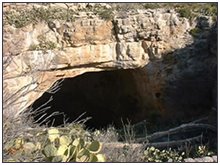
At dusk, literally hundred of thousands of Mexican Free-tailed bats exit the mouth of the cavern. Some appear to take their time while others blanket the sky, so dense is their flight pattern. The nightly exodus can last from 20 minutes to 2.5 hours as the last stragglers exit the cave. It is a truly extraordinary sight and well worth the wait.
There are three tours available at the caverns from 1.5 hours to a more strenuous tour that includes some crawling through narrow spaces. I chose the 1.5 hour tour (The Big Room) and stayed for the night flight of bats from the cave entrance. I highly recommend the Carlsbad Caverns as a terrific place to visit.