skip to main |
skip to sidebar
 They are sometimes called mazes or labyrinths but there is a slight distinction between the two terms. Generally, mazes are considered easier to negotiate since they have no blind alleys or dead ends. Labyrinths, on the other hand are considered a little more challenging. Webster’s Dictionary defines a labyrinth as “...a place constructed of or full of intricate passageways and blind alleys...something extremely complex or tortuous in structure, arrangement or character....” In any event, most writers tend to use the term maze and labyrinth interchangeably, as I will do in this column.
Mazes have been found throughout the world and appear to have early origins. In the 5th century BC, a Greek traveler, Herodotus, discovered a labyrinth in Egypt. He was so impressed with the size and complex nature of the labyrinth that he wrote “I found it greater than words could tell...even the pyramids were surpassed by the Egyptian labyrinth.” Herodotus also states that the labyrinth was built on two levels had 3,000 chambers and that a massive stone wall encircled the structure.
Some believe that mazes were created to admonish people who had behaved badly and therefore needed to reflect on their past conduct. These individuals would be placed in the center of the maze and asked to escape. In doing so, they would experience dead ends, blind alleys, interlocking triangles and concentric circles. It was hoped that as an individual tried to escape the confinements of a maze, he might equate those experiences to real life, and therefore consider his options more carefully and make better decisions in the future.
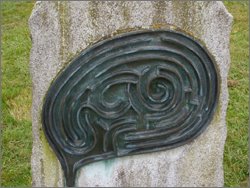
Seen in this photograph is an unusual headstone to Michael Ayrton who was known as a master maze builder. It holds an 18” double spiral bronze labyrinth replica of the Arkville labyrinth Ayrton in New York. The tombstone is located in St. Botolph’s churchyard in Essex, England. It is located on the north east corner of the churchyard on left-hand side of the gravel path. Visitors to Ayrton’s graveside have run their fingers through the bronze plaque trying to locate the beginning and end of the puzzle. Even in death, Ayrton still has the ability to perplex people.
An excerpt in Extraordinary Places…Close to London.
 Earl Steinbicker, who edited my book Extraordinary Places ... Close to London, has written or edited 17 books in a highly successful series called "Daytrips” and now he has launched a blog called Life’s Little Adventures.
From Earl's blog:
"• World Traveler • Commercial Photographer • Author • Book Editor • And More • I've been all of these, and now I'm older and ready to tell all that I've learned — back in the prehistoric times before computers — and how I've come to terms with today's technology. Hello, my name is Earl Steinbicker and I'll frequently include complete one-day adventures from my books that you can take, as experienced by myself and my little gang of travel writers. Along the way, you'll meet a few celebs (even living ones!), hear my rants about the publishing business, and experience some unusual happenings. Enjoy!"
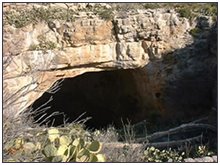
 Some people refer to Carlsbad Caverns as the eighth wonder of the world and on a recent visit, I can see why. Take the elevator 758 feet below the surface to see such impressive formations that are hard to describe here. The stalagmites and stalactites produced over thousands of years are spectacular. The caverns also host of hundreds of thousands of bats that leave each night on their nightly hunt for food.
A cowboy, Jim White first discovered the caves at Carlsbad but few people believed his tales of the beautiful formations under the ground. Then, in 1915, a friend, Ray V. Davis accompanied White to the caverns and took some photographs. Once those photographs were made public, scores of people visited the caves but it wasn’t until 1923 that the U.S. Department of the Interior took an interest and sent an inspector to assess the caverns and report his findings. The inspector, Robert Holly, was not prepared to see the magnificent formations that stood before his eyes. His report back to Washington, D.C. stated, “ I am wholly conscious of the feebleness of my efforts to convey in words the deep conflicting emotions, the feeling of fear and awe, and the desire for an inspired understanding of the Divine Creator’s work which presents to the human eye such a complex aggregate of natural wonders.”
At dusk, literally hundred of thousands of Mexican Free-tailed bats exit the mouth of the cavern. Some appear to take their time while others blanket the sky, so dense is their flight pattern. The nightly exodus can last from 20 minutes to 2.5 hours as the last stragglers exit the cave. It is a truly extraordinary sight and well worth the wait.
There are three tours available at the caverns from 1.5 hours to a more strenuous tour that includes some crawling through narrow spaces. I chose the 1.5 hour tour (The Big Room) and stayed for the night flight of bats from the cave entrance. I highly recommend the Carlsbad Caverns as a terrific place to visit.
 Does the fun and ownership justify the purchase price? We have been kayaking three times now and love the sport but are finding it hard to decide whether to purchase or continue renting? Equipment providers such as Grand Lake Sports (in Grand Lake Village www.grandlakeoutdoorsports.com) and Mountain Sports Kayak School (in Steamboat Springs on the top floor of the Conoco/Ski Haus building on Hwy 40 and Pine Grove Road) make in painless and simple to rent for about $55 per day. The purchase price depending on type of kayak you choose is somewhere between $350 and $1000 plus say $400 for a roof rack, so you can see you can rent for up to 25 days before the purchase option breaks even.
Another factor to consider is the relatively short window of opportunity for using kayaks in Colorado – just four months from June to September; and of course during these prime months, there are always other activities such as cycling, swimming and tennis to fit into the and around the kayaking plans! I do believe I have just talked myself into renting – at least for another year!
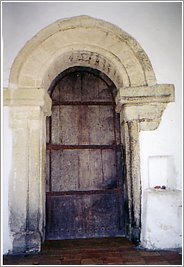
 Besides being one of the most beautiful churches in the area, the church of St. Botolph, in Essex, England, has been the focus of a legend for centuries. The legend was that of a Dane who had committed sacrilege was flayed alive and his skin was nailed to the door of the church. Some years ago, when the door was removed for renovations, human skin was found under one of the hinges on the ancient door. The skin was carefully removed, tested and determined to be human, so perhaps there was some truth to the legend! The skin is currently exhibited at the Saffron Walden Museum, Saffron Walden.Read more starting on page 68 in my book Extraordinary Places...Close to London available from Amazon or contact me directly via email.
Inside the pages of Tradition you’ll be delighted to find answers to age old questions regarding customs, traditions, myths and legends. The quarterly magazine is published in England and is devoted entirely to the ancient rituals and crafts of bygone days. The editor presents them to the reader in an interesting and thought provoking manner and states “we are peeling back the layers of modern society to reveal some of the ancient traditions lying just beneath the surface.”
Many of the myths, nursery rhymes and legends were brought to America and some have changed over the years to provide a softer, more politically correct version. For instance, the last line of the nursery rhyme Ring a Ring of Roses has been changed to all fall down instead of the all fall dead that I used to sing as a child.
Tradition magazine offers the reader anything and everything from witches’ customs to folk medicine, crafts and costumes and is well worth investigating.
Visit the Traditions web site here
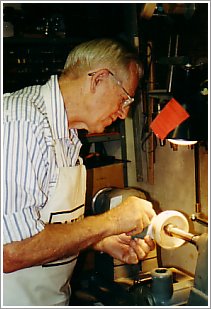
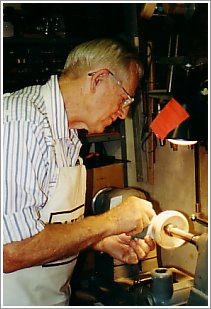
“I was angry at the world and if it hadn’t been for my grandfather and his friends…I don’t know what would have happened to me. They showed an interest in me and gave me a copy of Popular Science to read. At the age of 12 years, I bought my first lathe – it was an awaking for me and began my love of carpentry,” said Jim, a native of Greeley, Colorado.
“I love wood and the more exotic the better! Pink Ivory, Macassar Ebony, Purple Heart and Snake Wood can all be found in my workshop” Jim said with a smile. There’s nothing ordinary about Jim’s masterpieces or his passion for wood. “I admit to having an addiction to wood and tools and will purchase a piece of wood without the slightest idea how to use it,” he said.
Jim prefers the exotic and rare woods although they are difficult if not impossible to find at times. According to Jim, several years ago an unusual event took place. A shipment of Pink Ivory and Ebony was sold on the open market. A resourceful game hunter from Colorado visiting Africa heard the plans for a new reservoir. Knowing the value of the trees, and being a keen businessman, he purchased a truckload and shipped it immediately to the United States.
The news of the sale spread quickly to the various societies and clubs causing grown men to race to their trucks in anticipation of the purchase. It hadn’t always been so; pink ivory was such an expensive and negotiable commodity during the 1920s that sections were treated like negotiable bonds. This rare and sacred tree growing in the provinces of Transvaal and Natal in South Africa has been strictly controlled by the Zulu nation for centuries. Traditionally, only the chief can fell a tree; the penalty for unauthorized felling is swift and severe, sometimes death. It is a deciduous tree with a spreading crown and varies in height from under twenty feet to over fifty feet. The boles are usually seven to nine inches in quarter girth. It is hard and heavy; when air-dried the weight is 62lb per cu. ft. The fine, delicate pink hue in the wood is derived from the minerals and deposits in the soil. Controlled by the Zulu nation and usually impossible to acquire the shipment of pink ivory was sold for approximately $2 an ounce. Jim still has some small pieces of pink ivory from this shipment and has been known to collect the sawdust, mix it with a compound and use it on another project.
Over the years, Jim has designed and created many beautiful works of art. As a member of the International Wood Collectors’ Society, he constantly looks for rare or unique wood. He has noticed that women in particular have an affinity with Purple Heart, a vibrant and lively wood from Brazil and Central America and will ask for it to be used in their consignment. Jim frequently favors the almost stark white of the English Holly contrasting it with one of the Ebonies or an African Blackwood. “I rarely use a stain, unless requested by the customer; a beautiful piece of wood finished properly shouldn’t require much else.”