Wednesday, May 31, 2006

Kayaks – Purchase or Rent?


Does the fun and ownership justify the purchase price? We have been kayaking three times now and love the sport but are finding it hard to decide whether to purchase or continue renting? Equipment providers such as Grand Lake Sports (in Grand Lake Village www.grandlakeoutdoorsports.com) and Mountain Sports Kayak School (in Steamboat Springs on the top floor of the Conoco/Ski Haus building on Hwy 40 and Pine Grove Road) make in painless and simple to rent for about $55 per day. The purchase price depending on type of kayak you choose is somewhere between $350 and $1000 plus say $400 for a roof rack, so you can see you can rent for up to 25 days before the purchase option breaks even.

Another factor to consider is the relatively short window of opportunity for using kayaks in Colorado – just four months from June to September; and of course during these prime months, there are always other activities such as cycling, swimming and tennis to fit into the and around the kayaking plans! I do believe I have just talked myself into renting – at least for another year!

Sunday, May 21, 2006

The Legend of St. Botolph’s Church, Hadstock


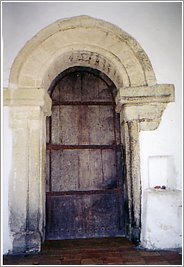
Besides being one of the most beautiful churches in the area, the church of St. Botolph, in Essex, England, has been the focus of a legend for centuries. The legend was that of a Dane who had committed sacrilege was flayed alive and his skin was nailed to the door of the church. Some years ago, when the door was removed for renovations, human skin was found under one of the hinges on the ancient door. The skin was carefully removed, tested and determined to be human, so perhaps there was some truth to the legend! The skin is currently exhibited at the Saffron Walden Museum, Saffron Walden.

Read more starting on page 68 in my book Extraordinary Places...Close to London available from Amazon or contact me directly via email.

Saturday, May 13, 2006

Ancient Traditions

Inside the pages of Tradition you’ll be delighted to find answers to age old questions regarding customs, traditions, myths and legends. The quarterly magazine is published in England and is devoted entirely to the ancient rituals and crafts of bygone days. The editor presents them to the reader in an interesting and thought provoking manner and states “we are peeling back the layers of modern society to reveal some of the ancient traditions lying just beneath the surface.”

Many of the myths, nursery rhymes and legends were brought to America and some have changed over the years to provide a softer, more politically correct version. For instance, the last line of the nursery rhyme Ring a Ring of Roses has been changed to all fall down instead of the all fall dead that I used to sing as a child.

Tradition magazine offers the reader anything and everything from witches’ customs to folk medicine, crafts and costumes and is well worth investigating.

Visit the Traditions web site here


Saturday, May 6, 2006

An Addiction to Wood


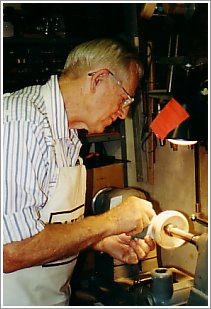
“I was angry at the world and if it hadn’t been for my grandfather and his friends…I don’t know what would have happened to me. They showed an interest in me and gave me a copy of Popular Science to read. At the age of 12 years, I bought my first lathe – it was an awaking for me and began my love of carpentry,” said Jim, a native of Greeley, Colorado.

“I love wood and the more exotic the better! Pink Ivory, Macassar Ebony, Purple Heart and Snake Wood can all be found in my workshop” Jim said with a smile. There’s nothing ordinary about Jim’s masterpieces or his passion for wood. “I admit to having an addiction to wood and tools and will purchase a piece of wood without the slightest idea how to use it,” he said.

Jim prefers the exotic and rare woods although they are difficult if not impossible to find at times. According to Jim, several years ago an unusual event took place. A shipment of Pink Ivory and Ebony was sold on the open market. A resourceful game hunter from Colorado visiting Africa heard the plans for a new reservoir. Knowing the value of the trees, and being a keen businessman, he purchased a truckload and shipped it immediately to the United States.

The news of the sale spread quickly to the various societies and clubs causing grown men to race to their trucks in anticipation of the purchase. It hadn’t always been so; pink ivory was such an expensive and negotiable commodity during the 1920s that sections were treated like negotiable bonds. This rare and sacred tree growing in the provinces of Transvaal and Natal in South Africa has been strictly controlled by the Zulu nation for centuries. Traditionally, only the chief can fell a tree; the penalty for unauthorized felling is swift and severe, sometimes death. It is a deciduous tree with a spreading crown and varies in height from under twenty feet to over fifty feet. The boles are usually seven to nine inches in quarter girth. It is hard and heavy; when air-dried the weight is 62lb per cu. ft. The fine, delicate pink hue in the wood is derived from the minerals and deposits in the soil. Controlled by the Zulu nation and usually impossible to acquire the shipment of pink ivory was sold for approximately $2 an ounce. Jim still has some small pieces of pink ivory from this shipment and has been known to collect the sawdust, mix it with a compound and use it on another project.

Over the years, Jim has designed and created many beautiful works of art. As a member of the International Wood Collectors’ Society, he constantly looks for rare or unique wood. He has noticed that women in particular have an affinity with Purple Heart, a vibrant and lively wood from Brazil and Central America and will ask for it to be used in their consignment. Jim frequently favors the almost stark white of the English Holly contrasting it with one of the Ebonies or an African Blackwood. “I rarely use a stain, unless requested by the customer; a beautiful piece of wood finished properly shouldn’t require much else.”

Sunday, April 30, 2006

The Forerunner of Shorthand?


Marcus Tullius Tiro was an ex slave born in a small village called Arpinum, in Italy about 60 miles south east of Rome. Tiro was an intelligent man who, in 63 BC, became secretary to Senator Cicero, a man who was known to enjoy hearing his own voice. He often gave long speeches in his own particular oratory style in the Senate of Rome. But, as Tiro watched and listened, he saw an opportunity to please and be of extra value to his master. He devised a method of recording his master’s speeches using his own specific marks that he could later transcribe to a proper written form. Cicero was delighted to know his speeches were recorded and could be read back to him verbatim.

Although the concept of recording speeches verbatim had been attempted by the Greeks many years earlier, it was Tiro who mastered the speed writing technique that is perhaps the forerunner of shorthand as we know it today. Tiro shared his technique with other scribes but it was not to stop there, soon Tiro’s Marks were taught in the schools of Rome. During Tiro’s employment for Cicero, he recorded more than 600 speeches and letters using his own specialized method of rapid writing.

Over the centuries, those people who had the ability to transcribe speeches and letters verbatim were highly valued employees. These scribes adapted and changed the characters to suit the particular employment, business or profession. Therefore only they could transcribe their own marks making that individual a highly prized employee.

Today, Pittman shorthand is the most commonly used method of taking dictation and recording speeches and letters. Even in the Houses of Parliament, London, speeches are still recorded verbatim by transcribers who work on rotation. The reporters work for five or ten minutes, then they re-dictate to a secretary who types up the transcripts.

Charles Dickens was just such a transcriber. He worked in the Houses of Parliament for almost six years and was well thought of by his colleagues. One contemporary described Dickens as “universally reputed to be the rapidest and more accurate shorthand-writer in the gallery” and another wrote, “A more talented reporter never occupied a seat in the Gallery of either House of Parliament.”

Here in the US, a fledgling Senate struggled with recording the speeches given by its members. A brochure called The Official Reporters of Debates of the U.S. Senate prepared under the direction of Walter J. Stewart, Secretary of the Senate, states that sometimes the reporters had difficulty hearing the speeches and even identifying the speaker. During the First Congress, Thomas Lloyd privately reported and published the debates describing the speakers as “the baldheaded man” or “the man in blue coat and wig.”


Assistant U.S. Senate Historian Betty K. Koed reported that “the last of the Senate's Reporters of Debates who used shorthand retired in the 1980s. Other reporters had begun using stenographic machines, in place of shorthand methods, in the late 1970s.”

While he served as majority leader of the United States Senate, Lyndon B. Johnson once observed that there were few documents more important than the congressional record “Locked in its pages are the debate, the resolutions, the bills, the memorials, the petitions...and that without the able, loyal, hard working, highly skilled corps of Official Reports who take down the debates.”

Sunday, April 23, 2006

Boadicea, Queen of the Iceni


Boadicea, Queen of the Iceni tribe, reigned over the counties we now East Anglia with her husband Prasutagus from approximately 48AD to 60AD. She was a fine woman by all accounts, standing as tall as a man with a booming voice that could not be ignored. The Greek, Dio Cassius, described her as “a Briton woman of the royal family” and of having a mass of red locks “the tawniest hair” that hung to her waist.

During the year 43AD, the Emperor Claudius sent approximately sixty thousand troops to finally subdue the Britons. The Iceni made peace with the Romans and Prasutagus was permitted to keep his kingdom until his death in 60AD.

On the eve of his death, Prasutagus wrote a will stating that half his kingdom would be left to his wife and two daughters. The other half would pass to Rome. Boadicea would be the beneficiary of her daughters’ inheritance until they came of age or when they married, in which case it would be used as a dowry.

The Romans saw Prasutagus’ death as an opportunity to seize the whole kingdom by claiming Prasutagus’ estate owed back taxes that were due immediately. Boadicea challenged the claim and, unable to justify the accusations, the Romans knew their scheme had failed leaving only one option. They instructed their soldiers to remove Boadicea by force, to crush and humiliate her.

Records of the time tell us that Boadicea was taken from her home and publicly flogged. The noblemen and women were heartbroken as they watched in horror at the treatment of their Queen. The shame was almost too much for Boadicea to bear, but the final blow came when her teenage daughters were taken from her and brutally ravaged by the Roman soldiers.

Queen Boadicea felt such fury and humiliation that she swore revenge on Rome and the Roman people and collected an army of over one hundred thousand people from various tribes that had never surrendered to the Romans and who now joined forces with the Iceni Queen.

First, Boadicea set her sights on Colchester, the foremost Roman city in England. The 9th Legion of the Roman army was guarding Colchester but they were no match for Boadicea and her soldiers. The city was quickly burned to the ground. News of Boadicea’s success spread through Britain and many people, sensing victory over the Romans, joined the fight. It is believed that Boadicea’s army totaled over 200,000 men and women at the final battle.

Boadicea’s next target was London. In anticipation of her arrival, the city was almost deserted but she kept her promise and pillaged and burned the town until nothing was left.

After the victories in Colchester and London, Boadicea and her army marched home full of triumph and accomplishment. They were greeted with cheers and happiness for ending the oppressive rule of Rome.

The Romans, ashamed and disgraced that a woman could inflict such devastation decided to use their best and most aggressive troops led by Suetonius Paulinus to contain the uprising. Paulinus commanded the 14th and 20th Legions who were known to be particularly fierce and combative. The legions had been fighting the Druids for control of Wales but now turned their attention south towards Boadicea’s army.

The actual location of the final battle site between the Roman legions and Boadicea is unknown but according to Tacitus, a Roman historian, Boadicea appeared “tired and injured, in her clan tartan and armed to the teeth…in appearance, almost terrifying.” Some say she was captured and died from poison taken by her own hand. Others say she died in prison from wounds inflicted during the battle. Either of these would have been preferable to being taken to Rome and subjected to harsh treatment or even execution in the gladiatorial arena.

Read more about Boadicea and Colchecter Castle in my book Extraordinary Places ... Close to London


Monday, March 13, 2006

What Do You See?


Each day as I walk past this tree stump, I see a face. Depending on the light, the deeply set eyes appear to be more pronounced, the long thin nose reminds me of someone – but whom?

On an impulse, I decided to email the image to some friends and family to see what they thought. I wanted to know if others also saw the same image. Only one friend said she could not see a face, and perhaps questioned my sanity. Susan couldn’t see anything except a stump with bark falling off. Well, there goes the imagination! But I can see an image, and he’s looking right back at me. Some friends and family tell me they see the face of Abraham Lincoln, while others can definitely see an image but can’t put a name to the face. Others have nicknamed him The Bark Man and The Man in The Tree. What do you see?